There is a specific temptation that waits for every person who decides to make their first film. It arrives the moment they open a blank document to write the script. The temptation is to be ambitious.
They imagine a story that spans multiple locations. They create a cast of characters, each with their own arc. They picture action sequences, montages, and emotional peaks that require careful choreography. They write a script that is fifteen or twenty pages long, convinced that length equals seriousness, and that complexity equals quality.
Then they try to produce it.
The Math of Scale
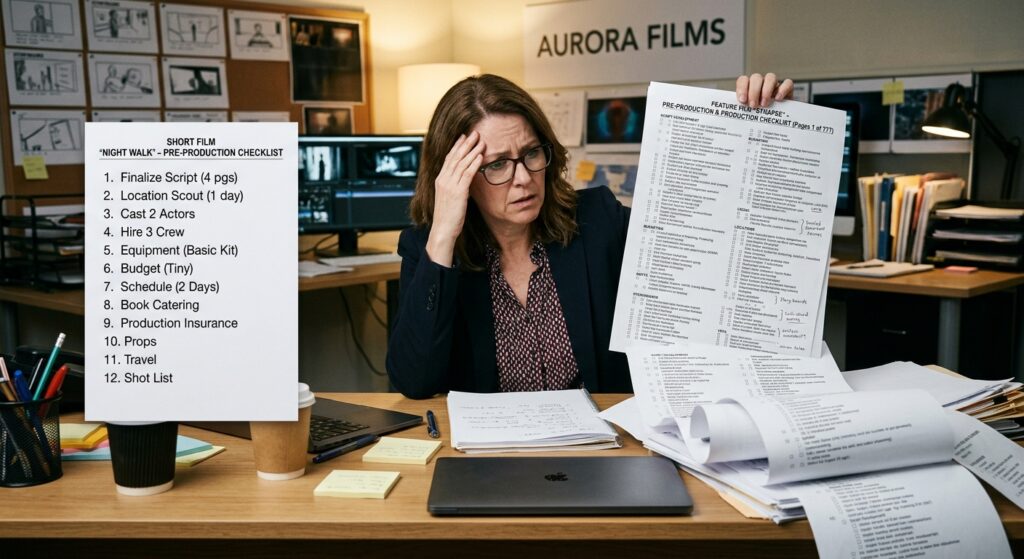
A twenty-minute film is not simply ten times longer than a two-minute film. It is exponentially more complex. Each additional location requires travel, permits, lighting setup, and sound control. Each additional character requires casting, scheduling, costume, and direction. Each additional scene requires coverage, which means more shots, which means more editing, which means more decisions.
A two-minute film with one location and two characters might require four hours of production time. A twenty-minute film with six locations and twelve characters might require four weeks. The beginner who chooses the twenty-minute path often discovers, somewhere around the third location, that they have underestimated the work by an order of magnitude. The project stalls. The footage sits on a hard drive. The film is never finished.
The unfinished film teaches nothing. The finished film, no matter how small, teaches everything.
Constraints as a Creative Tool
Working within tight boundaries is not a limitation. It is a focusing mechanism. When you have only two minutes, you cannot afford a subplot. You cannot afford a secondary character who exists only for exposition. You cannot afford a scene that does not move the story forward.
You are forced to identify the single thing your film is about. One relationship. One conflict. One shift. You must find the cleanest path from the beginning to the end, and you must make every frame justify its existence.
This discipline produces better work than freedom does. A painter with every color on the palette sometimes produces mud. A painter limited to three colors learns to see relationships they would have otherwise missed. The filmmaker with a two-minute limit learns to see the essence of their story.
What a Two-Minute Film Actually Looks Like
A woman sits at a kitchen table. Her phone rings. She does not answer. It rings again. She looks at the screen, hesitates, and sets it face down. A third call comes in. She picks up the phone, holds it to her ear, and says nothing. The caller speaks. Her expression changes. She hangs up. She looks out the window. The film ends.
That is one location. One character. One prop. One emotional shift. It could be shot in an afternoon. It could be edited in a weekend. And if it is done with attention to performance, framing, and sound, it will resonate more deeply than a twenty-minute film that loses its way.
The story is not in the scale. It is in the specificity.
The Danger of Fixing It in Post
Beginners often believe that mistakes made during production can be corrected during editing. This belief is especially destructive on long projects. If the pacing of a twenty-minute script is flawed, no amount of editing can save it. You cannot cut a slow scene into a fast one if the footage was shot slowly. You cannot create tension in the edit if the performances were flat on set.
A tight script does not need to be fixed in post because it was already correct on the page. When your film is two minutes long, you read the script aloud and you know immediately whether it drags. You feel the weight of every sentence. You cut the excess before you ever pick up a camera.
Editing becomes enhancement rather than rescue.
The Psychology of Finishing
There is a hidden benefit to small projects that has nothing to do with craft. It has to do with identity.
When you finish a film, even a two-minute film, you become someone who finishes films. That identity changes your behavior. You are more likely to start the next project. You are less likely to abandon it when difficulty arrives. You build momentum through completion, not through ambition.
The person who makes ten two-minute films in a year learns more than the person who spends a year on a single twenty-minute film that never gets completed. Each finished project teaches a specific lesson about writing, shooting, or editing. The lessons compound. The filmmaker improves.
The unfinished project teaches only that filmmaking is hard. Everyone already knows that.
How to Begin
If you are preparing to make your first film, write the simplest version of your idea. Reduce the locations to one. Reduce the characters to two. Reduce the runtime to two minutes or less. Find the single emotional transaction at the center of your story and build everything around it.
Do not worry that the result will seem small. Small is the point. Small is finishable. Small is where every filmmaker who ever became good started.
Make the film. Screen it for someone you trust. Listen to what they understood and what they did not. Then make the next one. Give yourself three minutes. Then four. Build slowly, project by project, until your ability matches your ambition.
There is no shortcut to skill. But there is a reliable path, and it begins with something you can actually complete.